Health and rights for children and young people
We know that children and young people can actively create a future of opportunity if given the right support.
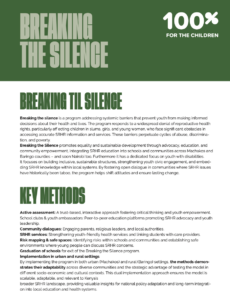
We have developed Breaking the Silence (BTS) as an approach that is now a core part of our health programmes, Designed to break taboos around sexual and reproductive health. The model trains teachers and youth ambassadors to create safe environments where children and young people can learn about their sexual rights and health. By 2024, more than 98 teachers and 120 youth ambassadors in Kenya, Ghana and Malawi were trained to address these sensitive topics in classrooms, making them more comfortable educating on sexuality and reproductive rights.
In our work with BTS, we have identified the need for better Access to water, sanitation and hygiene (WASH); needs that will only increase with climate change in the slum areas we work in. That's why part of our health programmes includes improving sanitation facilities so that they are both inclusive for children with disabilities, but also circular and maintainable by the local community. We are also developing educational modules in Kibera, Africa's largest urban slum, that empower children and young people to learn about inclusive hygiene and give them the tools to take responsibility for sanitation in their schools.
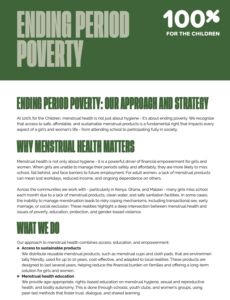
Access to reusable menstrual products is an important part of our health work. Through the distribution of reusable menstrual products and training on their use, our programmes have reduced school absenteeism among girls, often caused by menstruation. By 2027, we will ensure that up to 40,000 girls have access to reusable menstrual products and/or training on healthy menstrual hygiene, leading to a significant reduction in their school absenteeism. This initiative is part of a broader effort to Ensure girls can continue their education without interruption.
Child protection and safe growing conditions
We know that children and young people can actively create a future of opportunity if given the right support.
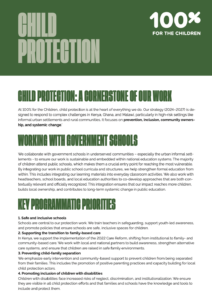
100% for Children's approach to child protection involves comprehensive safeguarding and risk mapping. Here, we identify and assess potential risks to child protection in different environments, including schools, shopping and homes.
We work closely together in partnerships to identify these risks and develop strategies to minimise them. In 2024, this approach helped create safe learning environments where children can thrive without fear of abuse or exploitation. In addition, we train teachers, community leaders and youth ambassadors to identify signs of abuse and implement effective protective measures.
We have reached over 200 organisations with educational materials on child protection.
Establishing and scaling child protection networks is important to strengthen the protection of children across different regions. That's why we are co-founders of The Danish Child Protection Network. In Kenya, we have co-founded the Kenyan Child Protection Network, which is a unifying platform for civil society organisations, line ministries and relevant national public authorities to coordinate efforts for the ongoing National Care Reform in Kenya.
As part of this effort, we are leading a programme in three major slum areas that strengthens family structures and community capacity to ensure child protection. The programme focuses on preventing violence, neglect and unnecessary separation of children from their families through positive parenting training, strengthening local child protection structures and targeted advocacy. In close collaboration with civil society organisations and authorities, the programme contributes to the implementation of Kenya's national Care Reform and ensures that children with disabilities are also included in protection efforts.
As part of ensuring child protection in vulnerable neighbourhoods, in 2025 we have also started building “Safe Spaces” where children and young people - especially young mothers - can find safety and get help to get an education.
Educating and empowering children and young people
We use peer-to-peer to promote education. Older students are trained to mentor and support their peers in both academic and personal matters. This method has proven particularly effective as students are often more receptive to advice and guidance from their peers.
This has particularly manifested itself in girls' clubs in Ghana, where older girls help younger ones navigate their schooling and personal challenges.
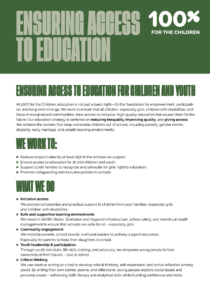
Teacher training is a cornerstone of 100% for Children's efforts to improve the quality of education. We conduct extensive training programmes with teachers focusing on inclusive, creative teaching methods and pedagogies with children's voices in focus.
For example, teachers in Kenya are trained to break the silence around sexuality and reproductive rights, which has made them better equipped to tackle these topics in the classroom, while we develop creative products as part of schooling.
We know that learning can best take place in a safe and secure environment. That's why we work hard to strengthen and manage the infrastructure at particularly vulnerable schools with many children.
Through physical improvements, safety measures and community involvement, we help create schools where children can learn and develop without fear.
This Year's Imprint 2025: 15,065 Children and Young People Strengthened – 17,335 Danes Engaged
Dive into our work in 2025 and see how we've made concrete changes for 15,065 children and young people across our initiatives – while also reaching and engaging 17,335 Danes on global challenges. With a focus on child protection, health, and education, we work towards lasting, inclusive solutions in Kenya, Ukraine, Ghana, and Malawi.
Read more about our work
At 100% for the Children, we work to break cycles of poverty for children and youth—especially those living in highly vulnerable and marginalized communities. We believe that sustainable change begins with local ownership, equality, and access to knowledge and rights. Below, you can download four of our key program briefs, offering insight into our work within child protection, menstrual health, access to education, and sexual and reproductive rights.